
Theodore G. Bilbo Papers
Description
Theodore G. Bilbo, the thirty-second governor of Mississippi, was perhaps the most controversial figure ever to serve as chief executive of the state.
He was born on October 13, 1877 at Juniper Grove in Pearl River County. He attended Vanderbilt University, and taught school for six years. In 1908 he was admitted to the bar in Tennessee but began the practice of law in Poplarville, Mississippi.
Bilbo entered politics in 1909 as state senator from the Fourth District. Before the end of his term an unsuccessful effort was made by the Senate to expel him after the first in his career of several accusations of accepting bribes. In 1911 Senator Bilbo was elected after a stormy campaign as lieutenant governor to serve with Governor Earl L. Brewer. Four years later he entered the race for governor and was elected over four opponents.
Governor Bilbo was inaugurated on January 18, 1916, and his administration during the next four years was as progressive as that of any in the history of the state. His administration instituted notable reforms in the highway system, in fiscal policies, and in education. Under his administration the State Tax Commission, the Mississippi Industrial Training School, the Game and Fish Commission, the State Plant Board, and the State Board of Embalming were established.
Bilbo was again a candidate for governor in 1923 but was defeated by Henry L. Whitfield. In 1927 he ran again, with M.S. Conner, A.C Anderson, and Governor Dennis Murphree as opponents. Although he led Governor Murphree by nearly 65,000 votes in the first primary, he was able to exceed him in the second by only a little over 10,000 votes.
Governor Bilbo was inaugurated the second time on January 17, 1928. The next four years were filled with controversies over a state-owned printing plant, brick roads, the removal of the University of Mississippi to Jackson, the firing of college presidents and professors, and the building of the Mississippi State Hospital at Whitfield. Two state officials were impeached; one resigned and one was exonerated. The Depression added to Governor Bilbo's troubles, so that when he went out of office in 1932, both he and the state were bankrupt.
In 1934 Governor Bilbo ran for the United States Senate against Senator Hubert D. Stephens, Ross A. Collins, and Frank H. Harper. Although Stephens led in the first primary, Governor Bilbo won in the second by about 6,000 votes. He was re-elected in 1940 over Governor Hugh L. White. In 1946 he defeated four opponents for a third term, but, again facing charges of accepting bribes, was refused his seat when he appeared to be sworn in the third time. He died in New Orleans on August 21, 1947.
He was born on October 13, 1877 at Juniper Grove in Pearl River County. He attended Vanderbilt University, and taught school for six years. In 1908 he was admitted to the bar in Tennessee but began the practice of law in Poplarville, Mississippi.
Bilbo entered politics in 1909 as state senator from the Fourth District. Before the end of his term an unsuccessful effort was made by the Senate to expel him after the first in his career of several accusations of accepting bribes. In 1911 Senator Bilbo was elected after a stormy campaign as lieutenant governor to serve with Governor Earl L. Brewer. Four years later he entered the race for governor and was elected over four opponents.
Governor Bilbo was inaugurated on January 18, 1916, and his administration during the next four years was as progressive as that of any in the history of the state. His administration instituted notable reforms in the highway system, in fiscal policies, and in education. Under his administration the State Tax Commission, the Mississippi Industrial Training School, the Game and Fish Commission, the State Plant Board, and the State Board of Embalming were established.
Bilbo was again a candidate for governor in 1923 but was defeated by Henry L. Whitfield. In 1927 he ran again, with M.S. Conner, A.C Anderson, and Governor Dennis Murphree as opponents. Although he led Governor Murphree by nearly 65,000 votes in the first primary, he was able to exceed him in the second by only a little over 10,000 votes.
Governor Bilbo was inaugurated the second time on January 17, 1928. The next four years were filled with controversies over a state-owned printing plant, brick roads, the removal of the University of Mississippi to Jackson, the firing of college presidents and professors, and the building of the Mississippi State Hospital at Whitfield. Two state officials were impeached; one resigned and one was exonerated. The Depression added to Governor Bilbo's troubles, so that when he went out of office in 1932, both he and the state were bankrupt.
In 1934 Governor Bilbo ran for the United States Senate against Senator Hubert D. Stephens, Ross A. Collins, and Frank H. Harper. Although Stephens led in the first primary, Governor Bilbo won in the second by about 6,000 votes. He was re-elected in 1940 over Governor Hugh L. White. In 1946 he defeated four opponents for a third term, but, again facing charges of accepting bribes, was refused his seat when he appeared to be sworn in the third time. He died in New Orleans on August 21, 1947.
Collection Items
Letter from P.I. Lipsey, N.S. Jackson, L.G. Gates, F.M. Purser, R.B. Gunter to Senator Theodore G. Bilbo, March 25, 1938
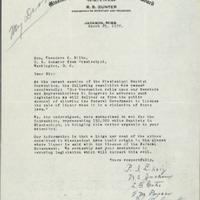
Letter from P.I. Lipsey, N.S. Jackson, L.G. Gates, F.M. Purser, R.B. Gunter as representative of the Mississippi Baptist Convention requesting Senator Bilbo's assistance in securing legislation that will stop the Federal Government from licensing the…
We Made History by Rose Upton Bascom
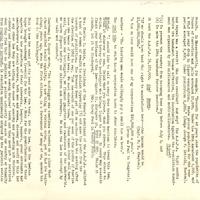
A document by Mrs. Rose Upton Bascom about the repeal of the 18th amendment.
Correspondence from Pastor J. E. Drane, Concord Baptist Church regarding Temperance
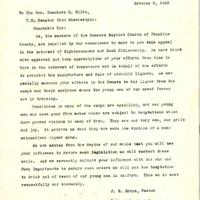
Short letter from Pastor J. E. Drane, Concord Baptist Church to Theodore Bilbo regarding efforts to promote temperance in armed forces training centers during World War II.