
An Appeal For Protective Legislation For Our Armed Forces Against The Liquor Traffic
Dublin Core
Title
An Appeal For Protective Legislation For Our Armed Forces Against The Liquor Traffic
Subject
Liquor laws, bills, and amendments - United States
Liquor license - United States
Temperance
Richmond, Virginia
Liquor license - United States
Temperance
Richmond, Virginia
Description
One-page appeal for protective legislation after the Conference of Church Workers against the liquor traffic.
Creator
Bishop James Cannon, Jr.
Source
M002 Bilbo (Theodore G.) Papers, Box 1054
Publisher
University of Southern Mississippi, Center for Digital Humanities
Date
circa 1940s
Rights
This collection may be protected from unauthorized copying by the Copyright Law of the United States (Title 17, United States Code). Permission for reproduction or publication must be obtained from the University of Southern Mississippi McCain Library & Archives.
Format
PDF: Typed Document
Language
English
Type
Text
Coverage
World War Two
Still Image Item Type Metadata
Added by
Alyssa Watrous-Hendrix
Original Format
Text
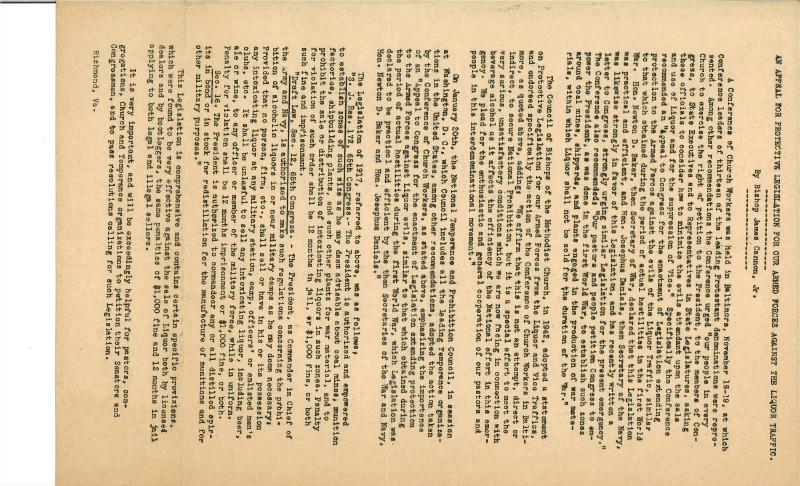
AN APPEAL FOR PROTECTIVE LEGISLATION FOR OUR ARMED FORCES AGAINST THE LIQUOR TRAFFIC
By Bishop James Cannon, Jr.
A Conference of Church Workers was held in Baltimore, November 18–19, at which Conference leaders of thirteen of the leading Protestant denominations were represented. Among other recommendations the Conference urged “our people in every Church to exercise the right of petition to the President, to the members of Congress, to State Executives and to Representatives in State Legislatures, asking these officials to consider how to minimize the evils attendant upon the sale and use of Liquor and for the suppression of Vice.” Specifically the Conference recommended an “Appeal to Congress for the enactment of Legislation extending protection to the Armed Forces against the evils of the Liquor Traffic, similar to that which obtained during the period of actual hostilities in the first World War. Hon. Newton D. Baker, then Secretary of War, declared that this Legislation was practical and efficient, and Hon. Josephus Daniels, then Secretary of the Navy, was likewise strongly in favor of this Legislation, and has recently written a letter to Congress, strongly urging similar Legislation for the present emergency.” The Conference also recommended: “Our pastors and people petition Congress to empower the President, as was done in the first World War, to establish such zones around coal mines, shipyards, and plants engaged in the production of war materials, within which Liquor shall not be sold for the duration of the war.”
The Council of Bishops of the Methodist Church, in 1942, adopted a statement on Protective Legislation for our Armed Forces from the Liquor and Vice Traffics, and endorsed specifically the action of the Conference of Church Workers in Baltimore, as quoted above, adding: “We affirm that this is not an attempt, direct or indirect, to secure National Prohibition, but it is a special effort to meet the very serious, unsatisfactory conditions which we are now facing in connection with beverage alcohol as it affects the efficiency of the National effort in this emergency. We plead for the enthusiastic and general cooperation of our pastors and people in this interdenominational movement.”
On January 20th, the National Temperance and Prohibition Council, in session at Washington, D.C., which Council includes all the leading Temperance organizations in the United States, among other recommendations, adopted the action taken by the Conference of Church Workers, as stated above, emphasizing the importance of an “Appeal to Congress for the enactment of Legislation extending protection to the Armed Forces against Liquor evils, similar to that which obtained during the period of actual hostilities during the first World War, which Legislation was declared to be practical and efficient by the then Secretaries of War and Navy, Hon. Newton D. Baker and Hon. Josephus Daniels.”
The Legislation of 1917, referred to above, was as follows:
“S.J. Res. 172, 65th Congress.—The President is authorized and empowered to establish zones of such size as he may deem advisable about coal mines, munition factories, shipbuilding plants, and such other plants for war material, and to prohibit the sale or distribution of intoxicating liquors in such zones. Penalty for violation of such order shall be 12 months in jail, or $1,000 fine, or both such fine and imprisonment.
“Draft Law, Sec. 12, 65th Congress.—The President, as Commander in Chief of the Army and Navy, is authorized to make such regulations concerning the prohibition of alcoholic liquors in or near military camps as he may deem necessary; Provided that no person, firms, etc., shall sell or have in his or its possession any intoxicating liquor at any military station, camp, officers’ or enlisted men’s clubs, etc. It shall be unlawful to sell any intoxicating liquor, including beer, ale or wine, to any officer or member of the military force, while in uniform. Penalty for violation shall be 12 months imprisonment or $1,000 fine, or both.
“Sec. 16. The President is authorized to commandeer any or all distilled spirits in bond or in stock for redistillation for the manufacture of munitions and for other military purposes.”
This Legislation is comprehensive and contains certain specific provisions, which were found to be very effective against the sale of Liquor both by licensed dealers and by bootleggers, the same penalties of $1,000 fine and 12 months in jail applying to both legal and illegal sellers.
It is very important, and will be exceedingly helpful for pastors, congregations, Church and Temperance organizations to petition their Senators and Congressmen, and to pass resolutions calling for such Legislation.
Richmond, Va
AN APPEAL FOR PROTECTIVE LEGISLATION FOR OUR ARMED FORCES AGAINST THE LIQUOR TRAFFIC
By Bishop James Cannon, Jr.
A Conference of Church Workers was held in Baltimore, November 18–19, at which Conference leaders of thirteen of the leading Protestant denominations were represented. Among other recommendations the Conference urged “our people in every Church to exercise the right of petition to the President, to the members of Congress, to State Executives and to Representatives in State Legislatures, asking these officials to consider how to minimize the evils attendant upon the sale and use of Liquor and for the suppression of Vice.” Specifically the Conference recommended an “Appeal to Congress for the enactment of Legislation extending protection to the Armed Forces against the evils of the Liquor Traffic, similar to that which obtained during the period of actual hostilities in the first World War. Hon. Newton D. Baker, then Secretary of War, declared that this Legislation was practical and efficient, and Hon. Josephus Daniels, then Secretary of the Navy, was likewise strongly in favor of this Legislation, and has recently written a letter to Congress, strongly urging similar Legislation for the present emergency.” The Conference also recommended: “Our pastors and people petition Congress to empower the President, as was done in the first World War, to establish such zones around coal mines, shipyards, and plants engaged in the production of war materials, within which Liquor shall not be sold for the duration of the war.”
The Council of Bishops of the Methodist Church, in 1942, adopted a statement on Protective Legislation for our Armed Forces from the Liquor and Vice Traffics, and endorsed specifically the action of the Conference of Church Workers in Baltimore, as quoted above, adding: “We affirm that this is not an attempt, direct or indirect, to secure National Prohibition, but it is a special effort to meet the very serious, unsatisfactory conditions which we are now facing in connection with beverage alcohol as it affects the efficiency of the National effort in this emergency. We plead for the enthusiastic and general cooperation of our pastors and people in this interdenominational movement.”
On January 20th, the National Temperance and Prohibition Council, in session at Washington, D.C., which Council includes all the leading Temperance organizations in the United States, among other recommendations, adopted the action taken by the Conference of Church Workers, as stated above, emphasizing the importance of an “Appeal to Congress for the enactment of Legislation extending protection to the Armed Forces against Liquor evils, similar to that which obtained during the period of actual hostilities during the first World War, which Legislation was declared to be practical and efficient by the then Secretaries of War and Navy, Hon. Newton D. Baker and Hon. Josephus Daniels.”
The Legislation of 1917, referred to above, was as follows:
“S.J. Res. 172, 65th Congress.—The President is authorized and empowered to establish zones of such size as he may deem advisable about coal mines, munition factories, shipbuilding plants, and such other plants for war material, and to prohibit the sale or distribution of intoxicating liquors in such zones. Penalty for violation of such order shall be 12 months in jail, or $1,000 fine, or both such fine and imprisonment.
“Draft Law, Sec. 12, 65th Congress.—The President, as Commander in Chief of the Army and Navy, is authorized to make such regulations concerning the prohibition of alcoholic liquors in or near military camps as he may deem necessary; Provided that no person, firms, etc., shall sell or have in his or its possession any intoxicating liquor at any military station, camp, officers’ or enlisted men’s clubs, etc. It shall be unlawful to sell any intoxicating liquor, including beer, ale or wine, to any officer or member of the military force, while in uniform. Penalty for violation shall be 12 months imprisonment or $1,000 fine, or both.
“Sec. 16. The President is authorized to commandeer any or all distilled spirits in bond or in stock for redistillation for the manufacture of munitions and for other military purposes.”
This Legislation is comprehensive and contains certain specific provisions, which were found to be very effective against the sale of Liquor both by licensed dealers and by bootleggers, the same penalties of $1,000 fine and 12 months in jail applying to both legal and illegal sellers.
It is very important, and will be exceedingly helpful for pastors, congregations, Church and Temperance organizations to petition their Senators and Congressmen, and to pass resolutions calling for such Legislation.
Richmond, Va
Physical Dimensions
Unknown
Citation
Bishop James Cannon, Jr., “An Appeal For Protective Legislation For Our Armed Forces Against The Liquor Traffic,” LIS 652 -Omeka Sandbox, accessed September 29, 2026, https://lis652omeka.usmcdh.org/items/show/34.