
Can alcohol win the war?
Dublin Core
Title
Can alcohol win the war?
Subject
Alcohol use
Description
Alcohol use
Creator
unknown
Rights
This collection may be protected from unauthorized copying by the Copyright Law of the United States (Title 17, United States Code). Permission for reproduction or publication must be obtained from the University of Southern Mississippi Mc Cain Library & Archives.
Format
PDF; Typed document
Language
Eng
Type
Text
Text Item Type Metadata
Added by
Kate Thomas
Text
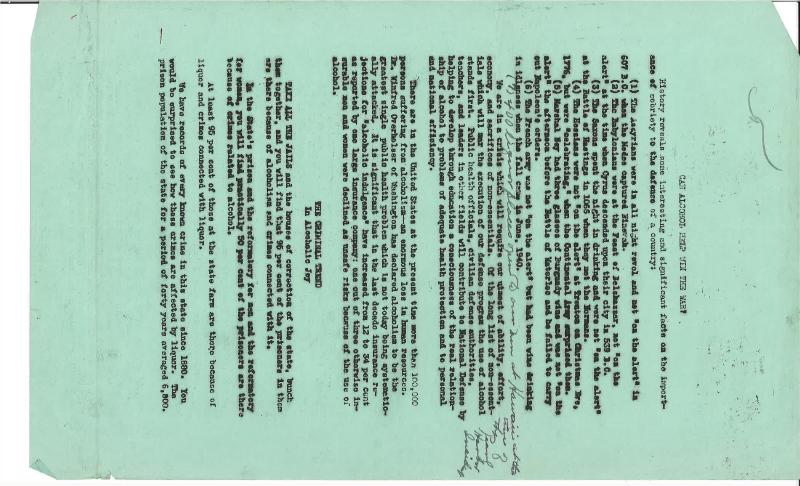
CAN ALCOHOL HELP WIN THE WAR?
History reveals some interesting and significant facts on the importance of sobriety to the defense of a country:
(1) The Assyrians were in all night revel and not “on the alert” in 607 B.C. when the Nedes captured Ninevah.
(2) The Babylonians were at the Feast of Belskasser, not “on the alert” at the time when Cyrus descended upon their city in 539 B.C.
(3) The Sarons spent the night in drinking and were not “on the alert” at the Battle of Hastings in 1066 when they met the Normans.
(4) The Hessians were not “on the alert” at Trenton on Christmas Eve, 1776, but were “celebrating,” when the Continental Army surprised them.
(5) Marshal ?ey had three glasses of Burgundy wine and was not “on the alert” the afternoon before the Battle of Waterloo and he failed to carry out Napoleon’s orders.
(6) The French army was not “on the alert” but had been wine drinking in idleness when the fall came in June, 1940.
(7) 400 liquor places open to our men at Hawaii at the time of the Pearl Harbor Incident.
We are in a crisis which will require our utmost of ability, effort, economy, and sacrifice of non-essentials. Of the long list of non-essentials which will mar the execution of our defense program the use of alcohol stands first. Public health officials, civilian defense authorities, teachers, and leaders in other fields will contribute to National Defense by helping to develop through education a consciousness of the real relationship of alcohol to problems of adequate health protection and to personal and national efficiency.
There are in the United States at present time more than 100,000 persons suffering from alcoholism – an enormous loss in human resources. Dr. Winfred Overholser of Washington has declared alcoholism to be the greatest single public health problem which is not today being systematically attacked. It is significant that in the last decade insurance rejections for “alcoholic indulgence: have decreased from 12 to 34 percent as reported by one large insurance company: one out of three otherwise insurable men and women were declined as unsafe risks because of the use of alcohol.
THE CRIMINAL TREND In Alcoholic Joy
TAKE ALL THE JAILS and the houses of correction of the state, bunch them together, and you will find that 96 per cent of the prisoners in them are there because of alcoholism and crimes connected with it.
In the State’s prison and the reformatory for men and the reformatory for women, you will find practically 50 per cent of the prisoners are there because of crimes related to alcohol.
At least 95 per cent of those at the state farm are there because of liquor and crimes connected with liquor.
We have records of every known crime in this state since 1880. You would be surprised to see how these crimes are affected by liquor. The prison population of the state for a period of forty years averaged 6,800.
History reveals some interesting and significant facts on the importance of sobriety to the defense of a country:
(1) The Assyrians were in all night revel and not “on the alert” in 607 B.C. when the Nedes captured Ninevah.
(2) The Babylonians were at the Feast of Belskasser, not “on the alert” at the time when Cyrus descended upon their city in 539 B.C.
(3) The Sarons spent the night in drinking and were not “on the alert” at the Battle of Hastings in 1066 when they met the Normans.
(4) The Hessians were not “on the alert” at Trenton on Christmas Eve, 1776, but were “celebrating,” when the Continental Army surprised them.
(5) Marshal ?ey had three glasses of Burgundy wine and was not “on the alert” the afternoon before the Battle of Waterloo and he failed to carry out Napoleon’s orders.
(6) The French army was not “on the alert” but had been wine drinking in idleness when the fall came in June, 1940.
(7) 400 liquor places open to our men at Hawaii at the time of the Pearl Harbor Incident.
We are in a crisis which will require our utmost of ability, effort, economy, and sacrifice of non-essentials. Of the long list of non-essentials which will mar the execution of our defense program the use of alcohol stands first. Public health officials, civilian defense authorities, teachers, and leaders in other fields will contribute to National Defense by helping to develop through education a consciousness of the real relationship of alcohol to problems of adequate health protection and to personal and national efficiency.
There are in the United States at present time more than 100,000 persons suffering from alcoholism – an enormous loss in human resources. Dr. Winfred Overholser of Washington has declared alcoholism to be the greatest single public health problem which is not today being systematically attacked. It is significant that in the last decade insurance rejections for “alcoholic indulgence: have decreased from 12 to 34 percent as reported by one large insurance company: one out of three otherwise insurable men and women were declined as unsafe risks because of the use of alcohol.
THE CRIMINAL TREND In Alcoholic Joy
TAKE ALL THE JAILS and the houses of correction of the state, bunch them together, and you will find that 96 per cent of the prisoners in them are there because of alcoholism and crimes connected with it.
In the State’s prison and the reformatory for men and the reformatory for women, you will find practically 50 per cent of the prisoners are there because of crimes related to alcohol.
At least 95 per cent of those at the state farm are there because of liquor and crimes connected with liquor.
We have records of every known crime in this state since 1880. You would be surprised to see how these crimes are affected by liquor. The prison population of the state for a period of forty years averaged 6,800.
Citation
unknown, “Can alcohol win the war?,” LIS 652 -Omeka Sandbox, accessed September 29, 2026, https://lis652omeka.usmcdh.org/items/show/32.